Pages Menu
TwitterRssFacebookPinterestGoogle Plus
Categories Menu

Posted on May 20, 2013 in Bergamo | 0 comments

Visit Bergamo: how to reach the Upper City?

Visit Bergamo: how to reach the Upper City?

Are you planning a trip in order to visit Bergamo? If the day is sunny and the temperature is warm, it’s worth a stroll to reach the Upper City in Bergamo. There are a lot of ways and steps that start from Lower City and reaching to the heart of the medieval village. They are made with cobbles and porphyry, except the one that runs along the Venetian Wall which is paved. As it is obvious they are all uphill, but they are not too demanding and the impression that you get while you walk is to be finished at the beginning of the 20th century, in an agricultural country. Right at the start of the funicular of viale Vittorio Emanuele II, for example, you can take one of these steps – Scaletta in italian – an old mule track that leads up to Porta San Giacomo, one of the four gates that allow access to the city. To get straight to the Centre of the Upper Town, in...

Read More
Posted on May 20, 2013 in Lakes, Villages | 0 comments

Fort Montecchio: ghosts of the Great War in Colico

Fort Montecchio: ghosts of the Great War in Colico

Colico is a city on the southern part of Lake Lecco. The surrounding area is distinguished by what is known as the four “montecchi”, or foothills that rise around the lake. It is from these foothills that Fort Montecchio North gets its name, an imposing military stronghold dug into the rock face. Fearing the tensions that would later transform into the First World War, the Kingdom of Italy decided to construct the fortress between 1913 and 1914. It was strategically located, at the entrance to the valleys that lead into Lombardy – Valchiavenna and Valtellina. Its purpose was to block an attacking enemy coming from Switzerland or Austria. From that single point, Italy could keep its two powerful neighbors to the north in check. The fort consists of two sections: the upper part is dominated by the four cannons and shelter for the troops, accommodating approximately 40 men. They are connected by a covered walkway of nearly 140 meters (460 feet) from which several crenels open. The fort has...

Read More

Posted on May 16, 2013 in Beach and coast, Villages | 0 comments

Violet Coast and Scilla: where the sea and legends intersect

Violet Coast and Scilla: where the sea and legends intersect

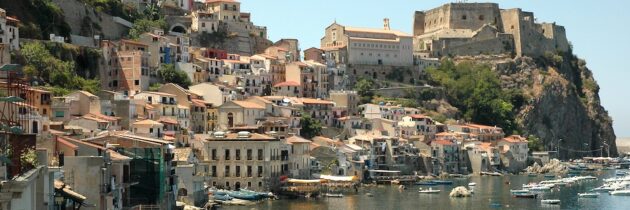
The Violet Coast is a jagged shoreline that, in some places, juts up vertically from the Tyrrhenian Sea, and in others, is gentler, offering beaches, caves and ravines where you can dive into the sea appropriately named for the color. The roads and towns that skirt the coast offer a view of the Aeolian Islands or of Sicily, which, on clear days, seem to gleam just beyond your reach. The Violet Coast extends for 35 kilometers (22 miles) from the Strait of Messina to Palmi. Of all the villages dotting this fascinating shore, Scilla is the one with the most history and splendor, existing in a balance between reality and myth. The name itself has ancient origins. In Greek mythology, Scylla was the sea monster whose top half was that of a woman while the bottom half had one or more tails and six ferocious dogs that were hidden at her waist. Scylla stayed on the peninsula side of the Strait, while on the Sicilian side, there lived another...

Read More

Posted on May 15, 2013 in Bergamo | 0 comments

Castello di San Vigilio: in the hills that surround Bergamo

Castello di San Vigilio: in the hills that surround Bergamo

It is not well known to the majority, but an ancient Castle is nestled in the hills that surround Bergamo, and is called Castello di San Vigilio. It is placed on the top of the hill to 500 meters in height and it dominates the landscape around. It shows a glimpse of Val Brembana and it offers a wide view of the Orobie Alps chain. It was built in order to safeguard and to control the territory. The first fortification dates back the VI century and in the IX century some clergymen built a small chappel there, dedicated to St. Mary Magdalene. Then, in 1166, the Bergamo municipality decided to build a fortress in that very place and in 1335 it was further enlarged in 1335 by The Visconti of Milan. Under the Dominion of the Republic of Venice, during the 15th century, the castle took on the shape and the sizes that still has and, thanks to construction of the Venetian Walls the building it has become an...

Read More