Pages Menu
TwitterRssFacebookPinterestGoogle Plus
Categories Menu

Posted on Jun 18, 2013 in Villages | 0 comments

Village of Soncino: fantasy and impregnable towers

Village of Soncino: fantasy and impregnable towers

In an agricultural plain, full of farms interspersed with small villages, ruins of ancient monastic communities as well as other fine examples of medieval and Renaissance architecture, you may chance upon Soncino, a village in the province of Cremona. The village is surrounded by a ring wall and is laid out in a rectangular pattern, evidence of its Roman roots. It is full of enchanting buildings and churches, but if you pass outside the city wall, your attention will undoubtedly be captured by the Castle. This castle belonged to the Sforza family, who dominated the city’s history for a long period, and built this fort in the twelfth century. In 1473, the engineer Bartolomeo Gadio began a series of modifications. The structure, made completely of brick, is characterised by four impressive towers, of which only the circular tower, the highest, was used as a lookout. The castle walls, which are remarkable for their width and height, were designed to withstand artillery fire. They were protected by battlements and had...

Read More
Posted on Jun 17, 2013 in Artists, Masterpieces | 0 comments

Raphael and the Portrait of a Young Woman (La Fornarina): the great beauty

Raphael and the Portrait of a Young Woman (La Fornarina): the great beauty

There is a scene in Paolo Sorrentino’s latest film, The Great Beauty, in which the main character is able to gain access to some of the most beautiful buildings in Rome at night, thanks to the help of a friend. One of these buildings is Palazzo Barberini, and, in a dream-like scene, the main character walks in front of Raphael’s Portrait of a Young Woman (La Fornarina), glancing at it with an enigmatic smile. This was certainly not a random choice by Sorrentino to include this painting in a film whose main theme is beauty. When looking at Raphael’s various masterpieces, what strikes you is their beauty and proportion, the equilibrium between the figures on the canvas and the rhythmic modulation of colors, his remarkable ability to organize form in space and to make the whole piece seem solemn and composed. Ultimately, what emerges from his works is their ease, simplicity and immediacy, but particularly their gracefulness and beauty. Raphael’s gracefulness emanates from his efforts to conceal artifice, but...

Read More

Posted on Jun 17, 2013 in Theatres | 0 comments

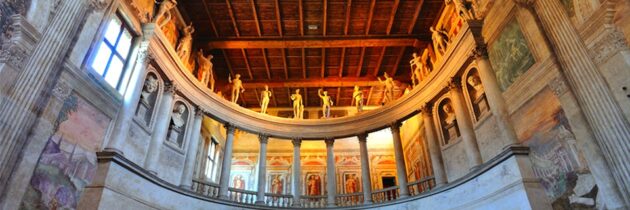
Teatro all’Antica in Sabbioneta: the first permanent theater of the modern era

Teatro all’Antica in Sabbioneta: the first permanent theater of the modern era

The concept of the ideal city first flourished in ancient times, but it was in the Renaissance that it became the focus of debate and came to be seen as the hub of human activity. This theme  brought forth a series of proposals, some utopian in nature, conceptualized in famous paintings such as the one displayed at the National Gallery of Marche, in Urbino, while other proposals were more concrete and realistic, including Sabbioneta, a small town not far from Mantua. The city dates back to Roman times, but was transformed through a project by Duke Vespasiano Gonzaga who, from 1554 to 1591 (the year of his death), created a polygon-shaped ring wall, with only two gates, to encircle the city. Inside the bastions, along the symmetrical layout of streets and squares, he planned a series of buildings, decorated with elaborate fresco cycles, and monuments with antique statues and sculptures, which made the small city center a fine example of urban planning in the classical style, particularly Roman. Teatro...

Read More

Posted on Jun 13, 2013 in Turin | 0 comments

Underground Turin: the tunnels of Pietro Micca

Underground Turin: the tunnels of Pietro Micca

It may be hard to imagine today, but Turin was, at one time, a fortified city. The first stone of the fortification was laid in 1564, on the orders of Duke Emanuele Filiberto, who wished to protect his new capital. The Citadel was laid out in a pentagon shape, with a stronghold at every angle, and surrounded by a wide moat. In 1706, in the middle of the Spanish war of succession, the Citadel was attacked by more than forty thousand soldiers of Louis XIV, and was able to repel the assault due to the well-planned defense system beneath the city. In fact, 14 kilometers of tunnels had been dug, consisting of main tunnels (the deepest levels) and service tunnels (closer to the surface). Recessed areas were dug into the tunnels, and then packed with explosives, which were then ignited as necessary by a slow-burning fuse. The explosion, calculated with the utmost precision, reverberated upwards, just beneath with enemies’ cannons. This was an effective and nearly invisible method of defending...

Read More