Posted on Jun 4, 2013 in Drinking |
Let’s start with the name. The traditional method is commonly known as Champagne, however this name is copyrighted, and cannot be used for wines produced outside that particular French region. The production process for these sparkling wines involves inducing a second fermentation after bottling through the addition of sugars, selected yeasts and mineral substances. Moving on to the numbers…. The pressure contained in a bottle of Franciacorta sparkling wine is approximately six atmospheres and, when opened, one and a half atmospheres are released in the form of bubbles. Once poured into the glass, the show begins in the form of bubbles that rise to the surface, the perlage. In...
Posted on Jun 4, 2013 in Parma, Villages |
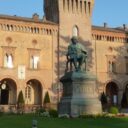
The area in which Giuseppe Verdi was born and raised and where his talent was first recognized – Roncole di Busseto, Busseto and Parma – have a spirit rich with song and melody. It is a sort of sweet poison that some say comes from the fog and the land and which affects and impassions the people of this region. It is evidenced in certain trattorias, where even today, you will eat and drink accompanied by Verdi’s arias, and in the formation of societies such as the 27 Club, which was created in a bar in 1958 and hosts animated discussions of opera, deriving its name from the number of operas Verdi composed....
Posted on Jun 3, 2013 in Masterpieces |
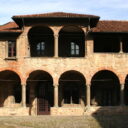
Near Vicenza, high up in the Berici hills, the upside-down keel shape of the Basilica Palladiana stands out in the city’s outline, the symbol of the historic center, which has recently been restored to its former glory. Palladio is the most recognized name in the area, after the artist that transformed architecture in the 1500s, giving rise to the model that bears his name and characterizes an entire region. UNESCO has included the Palladian villas in Veneto in its list of world heritage sites. Just a short distance from La Rotonda, the most celebrated of Palladio’s villas, you will find Villa Valmarana ai Nani. It was built 100 years...
Posted on May 30, 2013 in Masterpieces |
Buonconsiglio Castle in Trento has immense charm and fascination, rising just beyond the city walls that date back to the 1200s. The complex was the residence of the Prince-Bishops of Trento for nearly six centuries. One of its towers, known as Aquila, or Eagle, holds one of the most important fresco cycles from the International Gothic art movement in Europe: the Cycle of the Months. Even as you approach it, through a narrow passageway straight out of a fairy tale, the tower seems to want to separate the visitor from the rest of the castle and the world, to prepare him or her for a site that evokes ages...
Posted on May 29, 2013 in Bergamo |
Smartrippin, the first touristic app to discover the places to visit in Bergamo, offers the opportunity to know a charming city with a dual personality: its modern and dynamic lower part and its unmissable artistic and architectural upper part. Towards the end of the Nineteenth Century, the citizens of Bergamo needed a fast way to link the two parts of the city. In 1887 the solution was made: the cable car. The altitude gap is 85 meters and the maximum slope reaches 52%. The route lasts a few minutes but it is worth the effort. Beside the cable car, Bergamo has a great number of paths that link the...
Posted on May 21, 2013 in Masterpieces |
A walk to the Pincian Hill, in Rome, sets out before you one of the most celebrated vistas in the world. People like to look out over it and point to a monument, a silhouette, a cupola and say, “Oh yes, now I understand where it is”. At the back of the scenic overlook, surrounded by an expanse of holly oaks, chestnut trees, evergreens, statues and marble busts, is Villa Borghese, one of the largest parks in the country’s capital, which houses the Borghese Gallery. This was once Cardinal Scipione’s residence and today conserves priceless artistic masterpieces, including a number of works by Caravaggio and Bernini. But today we...
Posted on May 20, 2013 in Bergamo |
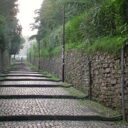
Are you planning a trip in order to visit Bergamo? If the day is sunny and the temperature is warm, it’s worth a stroll to reach the Upper City in Bergamo. There are a lot of ways and steps that start from Lower City and reaching to the heart of the medieval village. They are made with cobbles and porphyry, except the one that runs along the Venetian Wall which is paved. As it is obvious they are all uphill, but they are not too demanding and the impression that you get while you walk is to be finished at the beginning of the 20th century, in an agricultural...
Posted on May 20, 2013 in Lakes, Villages |
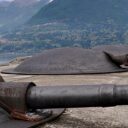
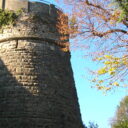
Colico is a city on the southern part of Lake Lecco. The surrounding area is distinguished by what is known as the four “montecchi”, or foothills that rise around the lake. It is from these foothills that Fort Montecchio North gets its name, an imposing military stronghold dug into the rock face. Fearing the tensions that would later transform into the First World War, the Kingdom of Italy decided to construct the fortress between 1913 and 1914. It was strategically located, at the entrance to the valleys that lead into Lombardy – Valchiavenna and Valtellina. Its purpose was to block an attacking enemy coming from Switzerland or Austria. From...
Posted on May 16, 2013 in Beach and coast, Villages |
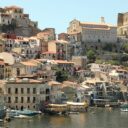
The Violet Coast is a jagged shoreline that, in some places, juts up vertically from the Tyrrhenian Sea, and in others, is gentler, offering beaches, caves and ravines where you can dive into the sea appropriately named for the color. The roads and towns that skirt the coast offer a view of the Aeolian Islands or of Sicily, which, on clear days, seem to gleam just beyond your reach. The Violet Coast extends for 35 kilometers (22 miles) from the Strait of Messina to Palmi. Of all the villages dotting this fascinating shore, Scilla is the one with the most history and splendor, existing in a balance between reality...
Posted on May 15, 2013 in Bergamo |
It is not well known to the majority, but an ancient Castle is nestled in the hills that surround Bergamo, and is called Castello di San Vigilio. It is placed on the top of the hill to 500 meters in height and it dominates the landscape around. It shows a glimpse of Val Brembana and it offers a wide view of the Orobie Alps chain. It was built in order to safeguard and to control the territory. The first fortification dates back the VI century and in the IX century some clergymen built a small chappel there, dedicated to St. Mary Magdalene. Then, in 1166, the Bergamo municipality decided...


 English
 Italian